

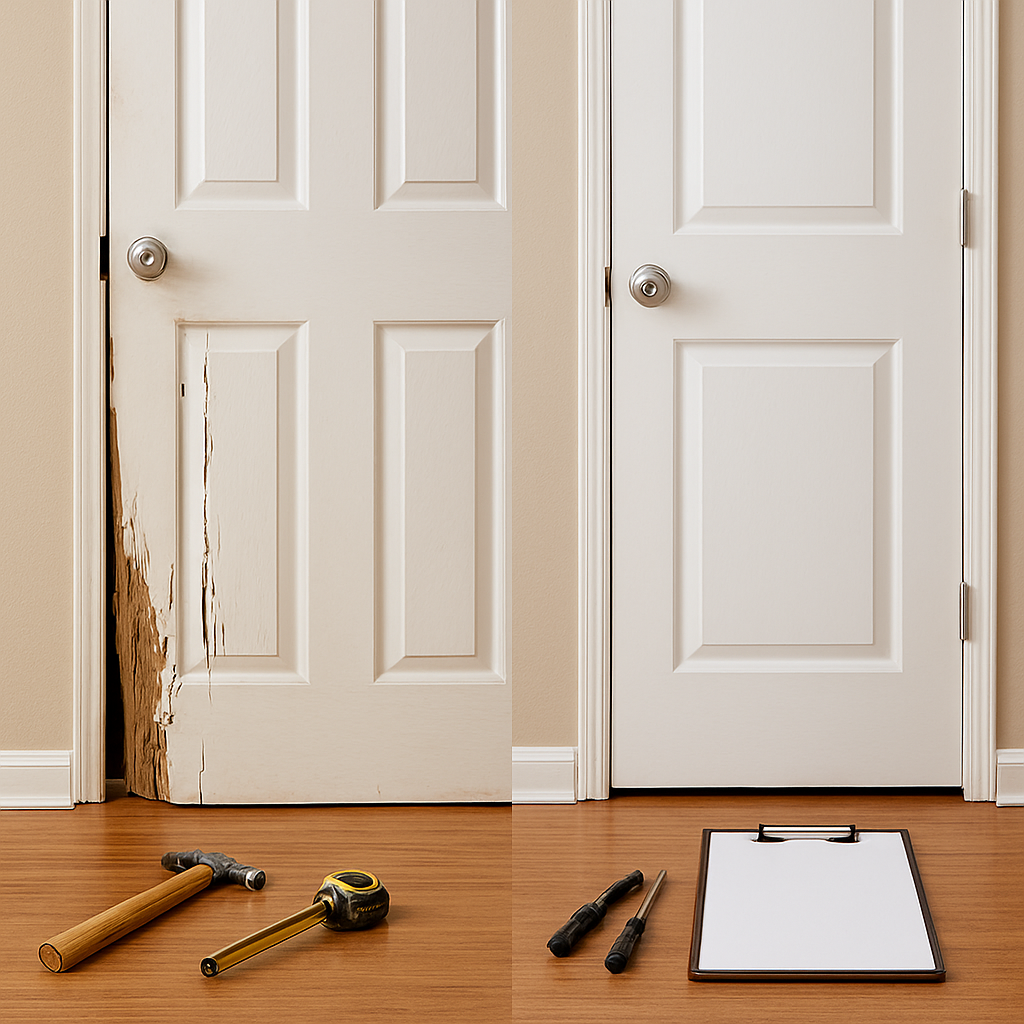
A failing door is rarely just an annoyance — it can leak energy, invite pests, or create a security risk. This door repair guide for Ocala and Marion County walks you through a simple inspection checklist, how to decide between repair and replacement, realistic local cost ranges, and how to find reliable local help. Read on to learn what to document, what to budget, and the questions to ask before you sign an estimate.
1. Quick visual and hands on inspection checklist for doors
Start with a goal: a five-minute inspection that tells you whether the issue is likely a simple hardware fix or something that needs professional door repair. Focus on what changes when the door moves, where water or air is getting through, and whether the frame is still solid — those three observations decide most repair vs replacement choices.
Exterior and interior walkaround
- Visual scan: Walk the perimeter looking for paint peeling at the bottom, gaps between jamb and door, visible rust on metal doors, and cracked or fogged glass.
- Open/close test: Operate the door slowly. Note if it sticks at one spot, scrapes the threshold, or fails to latch fully.
- Draft test: Move a lit incense stick or a thin strip of tissue slowly around the edges and the strike plate to reveal air movement without using an open flame.
- Gap measurement: Use a business card or a quarter to compare gaps top, side, and bottom; consistent gaps mean alignment, varying gaps mean sag or warp.
Hardware and simple hands-on checks
Check the fasteners: tighten hinge screws, then try replacing the shortest screw in the hinge with a 3-inch screw that reaches framing — this fixes a lot of sagging wood door problems. Limitation: if screws spin in soft or rotten jamb material, the fix is temporary and the jamb or sill likely needs repair or replacement.
Operate locks and latches: cycle the deadbolt and latch while watching the strike plate. If the bolt rides up or jams, try loosening the strike plate and repositioning it one screw hole over — that can cure misalignment without replacing the lockset. If a deadbolt turns freely or shows metal fatigue, treat it as a security risk and plan for professional replacement.
Frame, threshold and water checks (Florida attention points)
Probe for soft wood and signs of water: press a screwdriver tip into the sill and lower jamb where water pools. Soft spots or powdery wood mean rot or termite damage and usually push the decision toward replacement rather than a surface repair. In Ocala’s humid climate, tight weatherstripping can hide underlying sill decay until the rainy season reveals it.
Sliding, glass and specialty door tests
Sliding door quick checks: lift the panel slightly; a smooth lift indicates rollers are working. If the panel drops when you release it, the rollers are failing and a roller replacement or track service can salvage many sliding doors. Glass units: fogging between panes points to a failed insulated glass unit — often replaced without replacing the whole frame, conserving money and time.
Practical example: A homeowner in Ocala found their patio sliding door hard to open and visible rust on the track. After a quick lift test and rolling the panel, the technician replaced two rollers and cleaned the track — the door operated smoothly again and the owner avoided a full sliding door replacement.
Before you call a contractor: take 4 photos (full door, threshold, hinge/strike closeups, and any label or sticker on the door), note when the problem occurs (after rain, only in morning), and measure the visible gap where possible.
Judgment call that matters: homeowners overestimate structural failure when they see surface damage. If the frame is square and the wood is solid, most problems are cheaper and quicker to fix than replace. Conversely, if the inspection finds soft jambs, repeated hardware failures, or water tracking into the house, plan for replacement — patching is a short-term expense that usually returns.
Next consideration: document what you found, prioritize security and water intrusion issues first, and use your photos and notes when searching for door repair near me or requesting a written estimate to compare scope and price accurately.
2. Common door issues that are usually repairable
Most visible door problems don’t require a full replacement. In practice, issues fall into two recovery buckets: fixes that restore function and small interventions that extend service life. Knowing which is which saves time and money.
Everyday repairable problems and what a good repair looks like
Squeaks, sticky swings, and worn pivots. These are usually solved by replacing worn hinge pins or bushings and using the right lubricant, not by swapping the whole door. For heavy interior doors or bi-fold closets, replacing the pivot or guide rarely costs more than a service call.
Failed seals and weatherstripping. Old compressible foam, bulb seals, or threshold sweeps are inexpensive to swap and restore energy performance. The tradeoff: if the jamb or sill is already rotted, new weatherstripping only masks the underlying failure.
Damaged but intact glass panels. Cracked or chipped panes, and failed insulated glass units, can frequently be replaced without replacing the full door sash or frame. Judgment call: if the frame is warped or corroded, replacing the glass is a short-term fix that will look out of place and may repeat sooner.
Track, roller, and alignment issues on sliding and pocket doors. Cleaning the track, replacing worn rollers, and adjusting guides often restores smooth operation. For aluminum or vinyl frames common in Florida, replacement rollers and track tweaks are straightforward and cost effective.
Hardware failures on commercial or entry doors. Locksets, latches, closers, and sensors on automatic doors frequently require part swaps or recalibration. These repairs keep security and ADA function intact without full system replacement – but expect professional calibration on closers and automatic operators.
Garage door components. Broken springs, worn cables, and damaged rollers are repairable components. Safety note – spring and cable work should be performed by trained technicians because they store dangerous energy and improper repair causes injury.
- Common quick repairs: hinge pin replacement, weatherstrip swap, threshold sweep replacement, insulated glass unit swap, roller replacement
- When repairs are temporary: recurring seal failure, visible sill rot, badly bent frames, or repeated hardware failures
- Safety sensitive repairs: garage springs, automatic door motors, and structural jamb repairs should be handled by professionals
Concrete example: A small retail storefront in Ocala had an automatic sliding entry that kept stalling. The technician diagnosed a faulty activation sensor and corroded wiring, replaced the sensor and resealed the wiring harness – the operator ran reliably again and the owner avoided a costly full operator replacement.
Repair wins when the door leaf, frame, and structural threshold are sound. If the issue is recurring or tied to water damage, replacement is the smarter long term choice.
If you plan to call a technician, bring a few clear photos and note when the problem happens – after rain, at high humidity, or only in the morning. That context helps a provider estimate whether a targeted repair will be durable.
3. Clear signs you should replace rather than repair
Straight to the point: replace the door when the underlying structure is failing. Cosmetic fixes and hardware swaps are cheap and fast, but they do not fix compromised jambs, sills, or warped assemblies that undermine security, weatherproofing, and long term value.
Inspection findings that justify replacement
Extensive structural decay: if probing the sill or bottom of the jamb reveals soft, crumbling wood or termite damage, a repair is usually temporary. Tradeoff: patching buys time but increases total cost over a few seasons because water and pests continue to undermine fasteners and seals.
Persistent, repeated failures: multiple repairs in a short span – new rollers, new seals, straightened frame, and another leak within months – mean systemic failure. Spending repeatedly on band-aids rarely matches the lifespan and predictable performance of a new unit.
Severe leaf or frame distortion: doors that do not close without forcing, have large, uneven gaps, or have a permanently bowed leaf create security and energy problems. When alignment cannot be corrected by rehanging or jamb shims, replacement is more reliable and often cheaper over five years than endless adjustments.
Failed insulated units with corroded frames: replacing an insulated glass unit makes sense only if the sash and frame are square, rust-free, and weather tight. If aluminum, vinyl, or wood frames are corroded or warped, replace the whole assembly – new glass in a bad frame will fog or leak again.
Code or rating requirements: when you must meet Florida Building Code hurricane ratings, or an insurance claim specifies a rated door assembly, repairing an old, noncompliant door is a losing proposition. Contractors should document compliance – see Florida Building Code for details.
Security and safety failures: hardware that shows metal fatigue, deadbolts that turn freely, or snapped glazing stop being a maintenance issue and become a replacement priority. For commercial entryways or high-traffic residential doors, a compromised lock or frame is an immediate liability.
Practical example: A homeowner in Ocala had a front door that fogged between panes and required new weatherstripping every six months. On inspection the technician found rot at the threshold and expanding gaps at the jamb. Replacing the door assembly with a properly flashed, rated unit solved the leak and eliminated recurring repair costs over the next three years.
Judgment that matters: cheap repairs look attractive, but if two of the conditions above are present you should favor replacement. This avoids repeated service calls, prevents water or pest entry, and lets you select a door with better energy performance or hurricane rating when needed.
If you see structural rot, repeated failures, or code noncompliance, get two on site estimates that include photos, a clear scope for replacement, and documented product labeling. For local service and an on site assessment, consider requesting a visit from R C Windows & Doors.
Takeaway: replacement is the right choice when structural integrity, repeated failures, rating requirements, or security risks make repairs temporary or unsafe.
4. Cost comparison and local Ocala price ranges for repair versus replacement
Plain fact: small mechanical fixes nearly always cost a fraction of replacement, but the line where repair becomes wasteful is closer than most homeowners expect. Repair is the right move when the frame, threshold, and door leaf are fundamentally sound. Replacement is the right move when those components are compromised or when code or performance requirements demand a rated assembly.
Typical Ocala outlays – realistic local ranges
| Service | Common Ocala price band | Notes |
|---|---|---|
| Hinge and simple hardware replacement | $80 – $320 | Includes parts and one technician visit; premium locksets cost more |
| Weatherstripping and threshold swap | $75 – $260 | Range depends on profile, sill complexity, and whether trimming is required |
| Insulated glass unit replacement (entry or patio panel) | $220 – $900 | Higher for tempered or laminated / includes glass disposal |
| Sliding door roller and track service | $150 – $650 | Lower end is adjustment and cleaning, upper end includes new rollers and track repair |
| Standard exterior door replacement (installed) | $700 – $1,600 | Prehung units, basic finish, removal of old door included |
| Premium exterior or hurricane-rated door replacement | $1,500 – $3,500+ | Higher for custom sizes, sidelights, or specific wind rating documentation |
| Sliding glass door full replacement (installed) | $1,200 – $5,000 | Large panels, specialty glass, or structural modifications push price upward |
- Practical tradeoff: a repair that costs more than one third of a reasonable replacement is often worth questioning; replacements modernize seals and hardware and remove recurring service calls.
- Same-day or emergency door repair near me premiums: expect 20 to 50 percent surcharge for after-hours or guaranteed same-day mobilization, particularly for entry or garage doors.
- What to compare on estimates: materials brand and grade, labor hours, disposal, permit fees, and any warranty language that limits coverage for weather or humidity related failure
Concrete example: A homeowner in Ocala had a sticking wooden front door and draft. A local technician charged $260 to plane the jamb, rehang the door, and replace the weatherstripping. The owner chose that repair because the jamb wood probed solid. By contrast, when a different house showed soft sill wood and termite tracks, the on site quote for replacement was $2,100 because the frame had to be rebuilt and the new assembly flashed to code.
Judgment most clients miss: cheap visible repairs hide recurring costs when the underlying material is failing. If more than one component shows age – repeated seal failures, loose fasteners that no longer bite, or damp staining – replacement almost always has a lower total cost of ownership over three to five years.
Quick decision rule: if the quoted repair is greater than 30 percent of a like for like replacement, get a second opinion and a replacement quote that itemizes demolition, new materials, and permit costs.
5. Florida specific and code considerations for doors in Ocala
Direct point: in Ocala the single biggest non-technical reason a repair becomes a replacement is code, permit, or rating requirements. Homeowners routinely assume a simple fix will pass muster, but once a door affects the building envelope or hurricane resistance, the rules — and paperwork — change the decision.
Permits, when they matter, and who should handle them
Permit triggers: replacing a door that enlarges the opening, changes the header, or installs a hurricane-rated assembly often needs a permit in Marion County. Tradeoff: doing it yourself avoids permit fees but creates risk — your insurer or building inspector can require corrective work later. A qualified contractor will pull permits, supply installation records, and avoid you being stuck with unverified work.
Practical route: ask potential providers up front whether the job requires a permit and who will file it. If they say permits aren’t necessary for a full-frame replacement or rated assembly, get that in writing and verify with the county office. Refer to the Florida Building Code for the performance standards contractors must meet.
Hurricane-rated doors, labeling, and insurance consequences
Labeling matters more than marketing: hurricane-rated doors carry specific product labels and test numbers. Those stickers are not decorative — they prove the unit met structural and impact tests. If your replacement lacks that label, an insurer can deny claims after storm damage. Paying extra for a rated assembly upfront often reduces long-term insurance exposure and avoids requiring retrofits after an event.
Judgment: installers who cannot produce product labels, installation instructions, or an installation affidavit are a red flag. In practice, reliable installers document compliance, take photos, and provide the paperwork you need for permits and potential insurance requirements.
Material choices for Florida climates and maintenance tradeoffs
Material selection: Ocala heat and humidity favor non‑porous faces and corrosion‑resistant hardware. Fiberglass and sealed steel resist swelling and termite attack better than plain wood, but they cost more and can look less traditional. Aluminum frames with thermal breaks perform well for sliding and patio doors; choose tempered or laminated glass when impact resistance matters.
Tradeoff to accept: if you want the look of wood, budget for annual maintenance and tighter inspection windows. If low maintenance and code compliance are priorities, accept the higher initial cost of a rated fiberglass or steel assembly to avoid repeated repairs later.
Concrete example: an Ocala homeowner replaced a rotted front frame with a non‑rated prehung door to save money. At the next home insurance renewal the company required hurricane-rated openings; the homeowner then paid to replace the door again with a certified unit and submit label documentation. The second replacement cost could have been avoided by installing a rated door the first time.
Get the label. If a door affects the exterior envelope, insist on seeing the manufacturer label and an installation affidavit before paying in full.
Before scheduling work: ask the contractor to (1) confirm permit needs with Marion County, (2) show the product test label and installation instructions, and (3) commit to providing photos and paperwork on completion. If they refuse, get another bid.
6. How to find and vet reliable door repair and replacement professionals
Reality first: most failed door projects are not caused by materials but by poor installation or unclear scope. A good contractor tightens the right screws once and documents what they did; a poor one makes quick fixes that return as repeat calls. Focus your vetting on process and documentation, not just price.
A five-part vetting framework you can use on the phone and at the site
- Scope clarity: ask the contractor to describe, in plain language, what they will do and what they will not. Get them to say whether they will repair or replace the frame, sash, or only hardware. If they hedge, write down the uncertainty and demand a site estimate.
- Who does the work: confirm whether installers are employees, certified by the manufacturer, or subcontractors. Installer skill matters more than brand names for field-fit jobs like jamb rebuilds or precise glazing.
- Paperwork and proof: require proof of insurance, a written estimate that lists materials and labor separately, and a promise to provide product labels and an installation affidavit when work is done. Use Florida Building Code or your insurer as the benchmark for required documentation.
- Local references and recent jobs: ask for two jobs in Ocala or Marion County completed in the past 12 months with photos and a contact you can call. Contractors who cannot show recent local work are a higher risk.
- Terms and contingencies: get a clear timeline, payment schedule tied to milestones, a written warranty, and a stated approach for unseen issues (rot discovered after demolition, permit delays, etc.). Avoid open-ended verbal promises.
Tradeoff to accept: fastest response and same-day door repair often cost more and sometimes use generic parts to move quickly. If the problem is security or weather infiltration, same-day service is reasonable. For planned replacements, prioritize documented warranties and labelled products over speed.
Concrete example: a homeowner in Ocala contacted three providers after a sliding door roller failed. The cheapest offered a same-day visit and quoted a roller swap without inspecting the track. The mid-priced company inspected, photographed a bent track, and quoted roller replacement plus minor track straightening; the homeowner chose that option and avoided another failure two months later. The lowest bid returned the door to the shop twice and ultimately required the more complete service.
Before you hire: insist on photographic documentation before, during, and after work and confirm who keeps the product labels and warranty paperwork. Without those, insurance and future resale value suffer.
Quick verification steps: check the contractor on Florida DBPR where applicable, read recent Google Business Profile reviews, request two Ocala references, and ask for a draft estimate emailed to you before scheduling any work.
Final judgment: do not let low price or fast promises substitute for clear scope, labeled products, and a written warranty. Those three items are what stop repeat calls and save money over time.
7. What to expect from a professional service visit and example R C Windows & Doors process
Clear expectation: a professional door repair visit is diagnosis first, commitment second. The technician should confirm what is broken, show you the evidence, and offer staged options rather than a single pitch to replace everything.
Typical on site workflow
What the technician does on arrival: they examine the leaf, jamb, threshold, hardware, and operating envelope; take close photos; measure for parts or new units; and test operation under conditions you described (after rain, morning humidity, etc). Limitation: many issues only reveal themselves after removing trim or the threshold, so an initial estimate is often conditional and may become a firm price after limited demo.
- Previsit homeowner prep: clear the path to the door, move furniture, secure pets, and have any prior receipts or labels available; provide gate codes or keys if requested
- Triage and photographic record: technician documents defects and will often email or print labeled photos so you and the installer agree on scope
- Estimate structure you’ll see: itemized parts and labor, lead times for ordered glass or custom hardware, permit responsibility, disposal fees, and warranty terms
- Work staging and contingencies: expect language that covers hidden rot, rusted fasteners, or subframe repairs that can change price and schedule
- Completion and acceptance: a proper visit ends with an operational test, photographed before and after, and a signed acknowledgement of work performed and warranty paperwork
Practical tradeoff: same day door repair services are valuable for security and emergency weather protection, but they sometimes use universal parts that are stopgaps. For non emergency jobs, plan for a measured repair or replacement using manufacturer matched hardware to avoid repeat service calls.
Important: insist that any diagnostic fee be credited toward the repair or replacement if you accept the proposal and get clear, dated documentation of permit responsibilities and warranty coverage.
Key takeaway: walk through the estimate line by line during the visit. If the quote lacks photographs, serial or model numbers for materials, or a clear contingency for hidden damage, pause and request those items before you pay a deposit.
Final judgment: treat the service visit as your decision checkpoint. If the technician demonstrates a methodical inspection, documents findings, and offers staged options with clear contingencies, you have a vendor worth comparing. If the visit feels rushed, demands large deposits, or skips paperwork, decline and get another on site estimate.
8. Decision matrix and next steps for homeowners
Start with a simple scoring approach: assign each concern a score from 0 (no problem) to 3 (critical) across these categories: security and safety, structural integrity of jamb/threshold, operational performance, energy and weather tightness, code or rating requirements, and likelihood of recurrence. Add the scores — low totals point to repair, high totals point to replacement.
Scoring rubric and interpretation
How to read the total: if the top two categories (security and structural integrity) score 2 or 3, replacement is usually the correct path because safety and building-envelope failures are not long-term fixable by hardware swaps. If those are 0 or 1 and the highest scores are operational (rollers, hinges) or seals, prioritize repair.
Practical tradeoff: repairs are cheaper and faster but can hide an unstable substrate. Replacement costs more up front but removes uncertainty and delivers predictable performance, documented product labeling, and a fresh warranty. In practice, contractors win jobs by minimizing visible scope; you win by forcing staged inspection and documented acceptance criteria.
Concrete example: an Ocala homeowner had a patio sliding door that dragged and fogged between panes. Scoring: security 1, structure 1, operation 3, seals 2, code 0, recurrence 2 = medium total. Technician proposed roller replacement and IGU swap with a conditional caveat for hidden sill rot. Because structural risk was low, the homeowner accepted the repair and scheduled a follow-up inspection after the rainy season to confirm no hidden decay.
Actionable next steps (what to do now)
- Create a decision memo: take four photos, note operation symptoms and when they occur, and write your scored totals. Use this memo as the attachment when you request quotes so every contractor bids to the same scope.
- Request staged proposals: ask each contractor for (A) immediate stabilizing repair cost, (B) full replacement price with product labels and lead times, and (C) a capped contingency price if hidden damage appears after limited demolition.
- Set acceptance tests: include objective checks in the contract such as smooth operation across five cycles, latch alignment within one quarter inch, and photographed product labels and installation affidavit on completion.
- Plan timing based on urgency: secure: same-day stabilizing; weather/security risk: schedule within one week; noncritical upgrades: plan for a single, documented replacement slot in the next budget cycle via a written appointment.
Key judgment most homeowners miss: contractors will often quote the cheapest visible fix to win work. Insist on a conditional line item for subframe repairs with a maximum allowed change order or require limited demo before final pricing — that reduces surprises and prevents serial, low-value repairs.
If safety or water intrusion shows on inspection, stabilize now and get two documented options: targeted repair with warranty or full replacement with labels and an installation affidavit. Avoid taking only a verbal assurance.
Next step checklist: (1) prepare your decision memo and photos, (2) request staged, written proposals from at least two local providers, (3) confirm who will handle permits and produce product labels, and (4) schedule the work with acceptance tests and final photographed documentation.